From Skill to System: How to Build a Business Around What You Know
A skill allows you to create value. A system allows that value to be repeated, distributed and owned. Explore how to transform what you know into intellectual property, products, processes and a business designed to grow beyond your immediate labour.
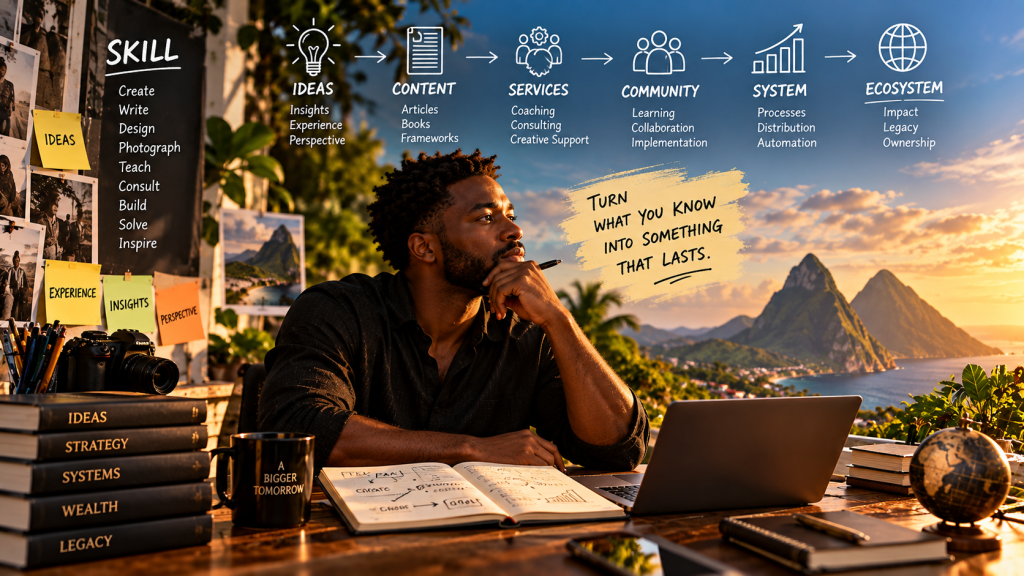

There is a familiar moment in the life of a skilled person.
You become good at something.
Perhaps you write.
Design.
Photograph.
Cook.
Teach.
Produce music.
Repair things.
Build websites.
Advise people.
Organize events.
Or solve a particular kind of problem so consistently that people begin coming to you whenever that problem appears.
Eventually someone says:
You should turn this into a business.
So you do.
You create a name.
Open a social media account.
Make a logo.
Perhaps build a website.
Customers begin arriving.
Money begins changing hands.
From the outside, you have built a business.
But sometimes what you have actually built is a job wrapped around your skill.
When you work, revenue happens.
When you stop, revenue stops.
Every new customer requires another conversation.
Another explanation.
Another proposal.
Another delivery.
Another round of decisions that somehow seem remarkably similar to the decisions you made last week.
The problem is not that your skill has failed.
The skill may be excellent.
The question is whether you have built anything around it.
Because there is a difference between knowing how to create value and building a system through which that value can repeatedly move.
The Skill Is Only the Raw Material
Being excellent at something is not the same as knowing how to build a business around it.
The distinction matters because skilled people often assume the quality of the work should be enough.
If the photographs are beautiful, people should come.
If the food is good, people should buy.
If the advice works, clients should refer others.
If the music is powerful, audiences should discover it.
Sometimes they do.
But a business requires more than the ability to produce something valuable.
It requires a way for people to discover that value, understand it, trust it, purchase it, receive it and, ideally, return to it.
The craft is one part of the architecture.
The business is what gets constructed around the craft.
This is where many talented people become stuck.
They keep improving the skill when the next problem is no longer skill.
It is structure.
Find the Knowledge Hidden Inside What You Do
One of the strange things about becoming good at something is that expertise eventually becomes difficult to see from the inside.
You simply do what you do.
A photographer walks into a room and immediately notices the light.
A designer notices hierarchy, spacing and imbalance.
A musician hears what is missing from an arrangement.
A consultant listens to a business owner describe a problem and recognizes a pattern they have encountered twenty times before.
An experienced teacher knows when a student is confused even before the student knows how to explain the confusion.
Expertise compresses knowledge.
What once required conscious thought eventually begins to feel like instinct.
That creates an interesting problem for the entrepreneur.
Some of your most valuable knowledge may be hiding inside things you no longer realize you know.
What feels like intuition to you may actually be undocumented intellectual property.
The photographer does not merely take photographs.
They understand composition, lighting, equipment, editing, storytelling, location, client expectations and perhaps how to make an uncomfortable person relax in front of a camera.
The producer does not simply make beats.
The chef does not simply cook.
The strategist does not simply give advice.
There are decisions inside the work.
Patterns.
Sequences.
Questions.
Standards.
Principles.
The beginning of systemization is learning to see them.

Document What You Keep Repeating
If you solve the same kind of problem repeatedly, there is probably a process underneath your work.
It may not yet have a name.
It may not be written anywhere.
It may exist only as a sequence of decisions you make almost automatically.
But it exists.
Begin there.
What questions do you always ask a new client?
What information do you need before beginning?
What mistakes appear repeatedly?
What do customers misunderstand before working with you?
What sequence tends to produce the strongest result?
What standards do you refuse to compromise?
What have years of experience taught you to notice quickly?
Write these things down.
Not because every business needs a hundred-page operating manual.
But because knowledge that remains entirely inside one person’s head is difficult to transfer, difficult to scale and surprisingly easy to lose.
Documentation is one of the first moments when a skill begins becoming an asset.
Stop Selling Only the Hour
There is nothing inherently wrong with exchanging time for money.
This point deserves emphasis because entrepreneurship culture sometimes treats service work as though it were a primitive stage everyone should escape.
It is not.
A skilled consultant can build an excellent business.
So can a barber.
A therapist.
A photographer.
A designer.
A tradesperson.
A coach.
Human attention can itself be extraordinarily valuable.
The better question is not whether you should stop selling your time.
It is whether every unit of value your business creates must require another unit of your direct labour.
That is a different question.
A consultant may notice that the same foundational questions appear in nearly every engagement.
Those questions could become an assessment.
A designer may repeatedly explain the same principles to clients.
Those explanations could become a guide.
A teacher may teach the same foundational material every term.
Some of that instruction could become recorded material, a workbook or a structured curriculum.
A writer’s ideas can become essays.
Essays can become books.
Books can continue carrying ideas into rooms the writer never physically enters.
This is not about removing the human being from the work.
It is about refusing to make your immediate presence the only place where your value can exist.
Turn Your Method Into Intellectual Property
There comes a point when repeated experience begins forming a method.
This is where expertise becomes particularly interesting.
Perhaps you have developed a particular way of helping clients clarify a problem.
Perhaps you have a sequence for taking someone from an idea to a finished creative project.
Perhaps your years in an industry have taught you a set of principles that consistently prevent expensive mistakes.
Perhaps you have developed a framework without realizing that it is a framework.
Name it.
Document it.
Refine it.
Test it.
Teach it.
Package it where appropriate.
Protect it where appropriate.
The moment your knowledge becomes sufficiently clear that another person can understand, apply or learn from it, something important has happened.
Your expertise is no longer entirely trapped inside your labour.
It has begun taking form.
That form might eventually become a book.
A workshop.
A curriculum.
A template.
A licensing model.
A digital product.
A standardized service.
A methodology that employees can learn.
Or a framework around which an entire company is eventually built.
This is one of the deeper transitions from skill to system.
A Business Should Remember What You Have Already Learned
One sign of a weak system is that the business keeps forgetting.
You solve a problem in January.
Then solve essentially the same problem again in March.
You write an excellent explanation for one customer.
Then rewrite it from scratch for the next.
You discover a better way of onboarding clients.
But because it was never documented, six months later you are back to improvising.
The individual is learning.
The business is not.
A system changes that.
Frequently asked questions become resources.
Repeated explanations become templates.
Successful processes become workflows.
Lessons from failure become safeguards.
Decisions that once required ten minutes of thought become standards.
Over time, the business develops memory.
And business memory is a form of leverage.
ThaPoetic1: From Ideas to an Ecosystem
ThaPoetic1 itself offers a useful example of this process.
Not because the system is finished.
It is still evolving.
That is precisely why it is useful.
At the centre of ThaPoetic1 is not a particular product.
It is a body of thought.
Ideas around creativity, alignment, sovereignty, wealth, identity, purpose, ownership and legacy.
Those ideas could remain thoughts.
They could remain private journal entries or conversations that disappear when the conversation ends.
Or they can be given form.
An idea becomes an essay.
A body of thought becomes a book.
Experience becomes a framework.
A framework for helping someone examine where they are and where they are trying to go becomes a Creative Alignment Session.
Recurring conversations around building meaningful work, wealth and legacy become the Legacy Builders Network.
The archive of ideas becomes a website.
Readers become an audience.
An audience, when treated with care rather than merely marketed to, becomes a relationship.
The accumulated body of work becomes intellectual property.
And increasingly, the processes surrounding that work can themselves become systems.
Even the way ThaPoetic1 develops articles is an example.
A writing voice can remain something understood only intuitively.
Or its principles can be examined.
What does the brand believe?
Who is it speaking to?
What does it refuse to sound like?
How should an idea unfold?
When should Caribbean context be present?
When should it not be forced?
How should readers be invited deeper into the ecosystem without turning every essay into an advertisement?
Once those decisions are articulated, they no longer have to be reinvented from zero every time.
That is systemization.
The system does not replace the thinking.
It preserves what the thinking has already learned.
From Product to Ecosystem
This is where business building can become more interesting than simply creating another thing to sell.
One body of knowledge can produce several expressions of value.
A free article may introduce an idea.
A book may explore that idea with greater depth.
A session may help someone apply the thinking to their particular circumstances.
A community may create an environment where implementation continues over time.
These are different products.
But they do not have to be unrelated products.
The strongest ecosystem has a common intellectual centre.
Everything feels as though it belongs to the same conversation.
This is an important distinction.
Adding more products does not automatically create a stronger business.
Sometimes it simply creates more things to maintain.
An ecosystem should create coherence.
One part should naturally introduce another.
The article leads toward the book because the reader wants depth.
The book leads toward the service because the reader wants application.
The service may lead toward the community because the person wants continued implementation and relationship.
Each layer has its own value.
Together, they create architecture.

Distribution Is Part of the Product
There is another uncomfortable lesson many skilled people eventually encounter.
Making something valuable does not guarantee that people will discover it.
Distribution is part of the business.
People need a path.
They need some way to discover you.
Some way to understand what you do.
Some reason to trust you.
Some clear way to purchase.
And, if the relationship remains valuable, some way to stay connected.
This is why content can matter commercially without becoming empty marketing.
A useful essay can be discovered through search.
The essay demonstrates how you think.
Your thinking helps the reader decide whether your worldview resonates with them.
Another article deepens that relationship.
A book may take it further.
Eventually, a reader may need the kind of help your business provides.
That process may happen in an afternoon.
Or over two years.
Both matter.
Not every piece of content has to close a sale.
Some content simply opens a door.
Systems Should Protect the Creative
For artists and creative people, the word system can sound suspicious.
It can evoke bureaucracy.
Spreadsheets.
Automation.
Standard operating procedures.
Corporate language applied to work that once felt alive.
But that is not what a good system has to be.
The purpose of a system is not to turn the creator into a machine. It is to prevent the creator from having to behave like one.
A good system handles what does not require your full creative intelligence.
It remembers the repetitive things.
It reduces avoidable decisions.
It creates consistency where consistency is useful.
It makes expectations clearer.
It gives other people the ability to participate in the work without requiring constant supervision.
And ideally, it returns human energy to the places where human energy matters most.
Judgment.
Imagination.
Relationships.
Strategy.
Creation.
The system should protect the craft.
Not suffocate it.
AI Can Accelerate a System. It Cannot Invent Its Meaning.
Artificial intelligence makes this conversation particularly relevant now.
For a skilled person, AI can help organize information, draft documentation, summarize repeated patterns, support customer communication, assist research, generate variations, automate parts of workflows and make previously expensive forms of leverage more accessible.
That is significant.
But there is an important sequence.
Understand first.
Systemize second.
Automate third.
Otherwise we simply automate confusion.
A business with no clear philosophy does not become thoughtful because it uses AI.
A weak process does not become intelligent simply because software performs it faster.
The real leverage appears when human knowledge has already been clarified enough to work with.
ThaPoetic1’s own content system is useful here.
The valuable part is not merely that artificial intelligence can generate sentences.
Sentences are cheap.
The deeper asset is the body of ideas, editorial philosophy, audience understanding, cultural awareness, standards, tone, ecosystem knowledge and accumulated decisions that tell the technology what kind of work belongs within ThaPoetic1 in the first place.
The leverage does not come from AI alone. It comes from combining human intellectual property with systems capable of expressing it.
The same principle can apply far beyond writing.
AI becomes more useful when there is already something worth amplifying.
Do Not Automate the Relationship Away
There is also a danger in becoming too enthusiastic about systems.
Not everything should be automated.
Not every interaction should become a funnel.
Not every customer should feel as though they are moving through machinery.
There are moments when a human conversation is the product.
Moments when nuance matters.
Moments when a customer needs to be heard rather than processed.
Moments when the artist’s touch is precisely what makes the work valuable.
Systemization should help us distinguish between what needs humanity and what merely consumes human time.
That distinction is where intelligent leverage begins.
Build a Business That Can Learn Without Starting Over
Over time, the goal is not simply efficiency.
It is accumulation.
Each project should teach you something.
Each customer should reveal something.
Each mistake should improve something.
Each successful process should leave behind something reusable.
This is how a business begins compounding knowledge.
Five years of work should ideally produce more than five years of invoices.
It should leave behind better processes.
Better judgment.
Stronger intellectual property.
Deeper customer understanding.
A larger archive.
Better distribution.
Stronger relationships.
Greater reputation.
More capable systems.
And ideally, assets that did not exist when you began.
Otherwise experience can pass through a business without becoming part of it.
The Deeper Shift Is From Labour to Ownership
A skilled person owns their ability.
That matters.
But as the business develops, there are other things they can begin to own.
Their methodology.
Their brand.
Their intellectual property.
Their content archive.
Their books.
Their frameworks.
Their processes.
Their direct relationships with customers and readers.
Their distribution channels.
Their reputation.
Their institutional knowledge.
This is where entrepreneurship begins becoming something larger than self-employment.
Labour creates today’s value.
Ownership allows some of today’s value to remain available tomorrow.
This does not mean every entrepreneur needs to build an enormous company.
Scale is not the only definition of success.
A one-person business can be beautifully designed.
A small studio can be enough.
A craft business can intentionally remain intimate.
The point is not to become bigger for the sake of becoming bigger.
The point is to become more deliberate about what remains after the work has been done.
Look at What You Already Know
If you have been doing something well for years, you may already possess more raw material than you realize.
Look at the questions people repeatedly ask you.
Look at the problems they repeatedly pay you to solve.
Look at the explanations you have given dozens of times.
Look at the mistakes experience has taught you to avoid.
Look at the process you follow without thinking.
Look at the principles beneath your best work.
Then ask:
What here could become a method?
What could become an asset?
What could become a product?
What could become a process someone else can follow?
What could continue creating value after today’s work is finished?
These questions begin moving us from skill toward system.
From What You Know to What You Build
Perhaps the most useful question is no longer:
How can I make more money from what I know?
There is nothing wrong with that question.
But another question reaches further:
What can I build around what I know?
The first question can produce more transactions.
The second can produce assets.
It can produce systems.
Intellectual property.
Products.
Processes.
Distribution.
Community.
Institutional memory.
Perhaps even something capable of continuing beyond your immediate presence.
The transition does not happen overnight.
Most businesses are built gradually.
One documented process.
One clearer offer.
One piece of intellectual property.
One distribution channel.
One lesson captured instead of forgotten.
Eventually the business begins remembering.
Then it begins compounding.
Then something that once existed only as your personal ability begins developing a structure of its own.
Your skill may be where the business begins.
It should not have to be where the business ends.
Build Beyond the Skill
If you are already good at what you do but can feel the limits of carrying the entire business through your own labour, the next stage may not require another skill.
It may require architecture.
The Legacy Builders Network exists for people thinking seriously about meaningful work, ownership, business, wealth and the systems required to turn ideas into something more durable.
It is a space for moving beyond inspiration and into the longer work of building.
Explore the Legacy Builders Network →
If your challenge comes earlier—if you know you have experience, ideas or abilities but cannot yet see the clearest structure around them—a Creative Alignment Session may offer space to examine what you are actually building, what belongs at the centre of it, and what the next stage could become.
The goal is not to turn everything you know into a product.
It is to recognize what deserves to become an asset—and to build the systems capable of carrying it.