Assets vs Income: Why Earning More Is Only the Beginning
Earning more can improve your life, but income alone does not guarantee wealth. Explore the deeper difference between income and assets—and how retaining, owning, building and compounding can create a stronger financial future.
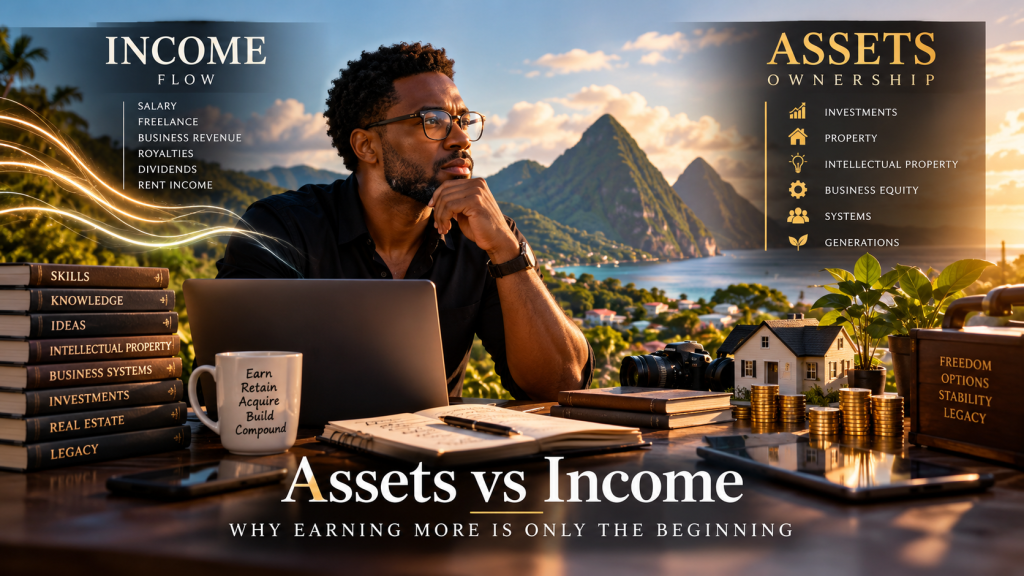
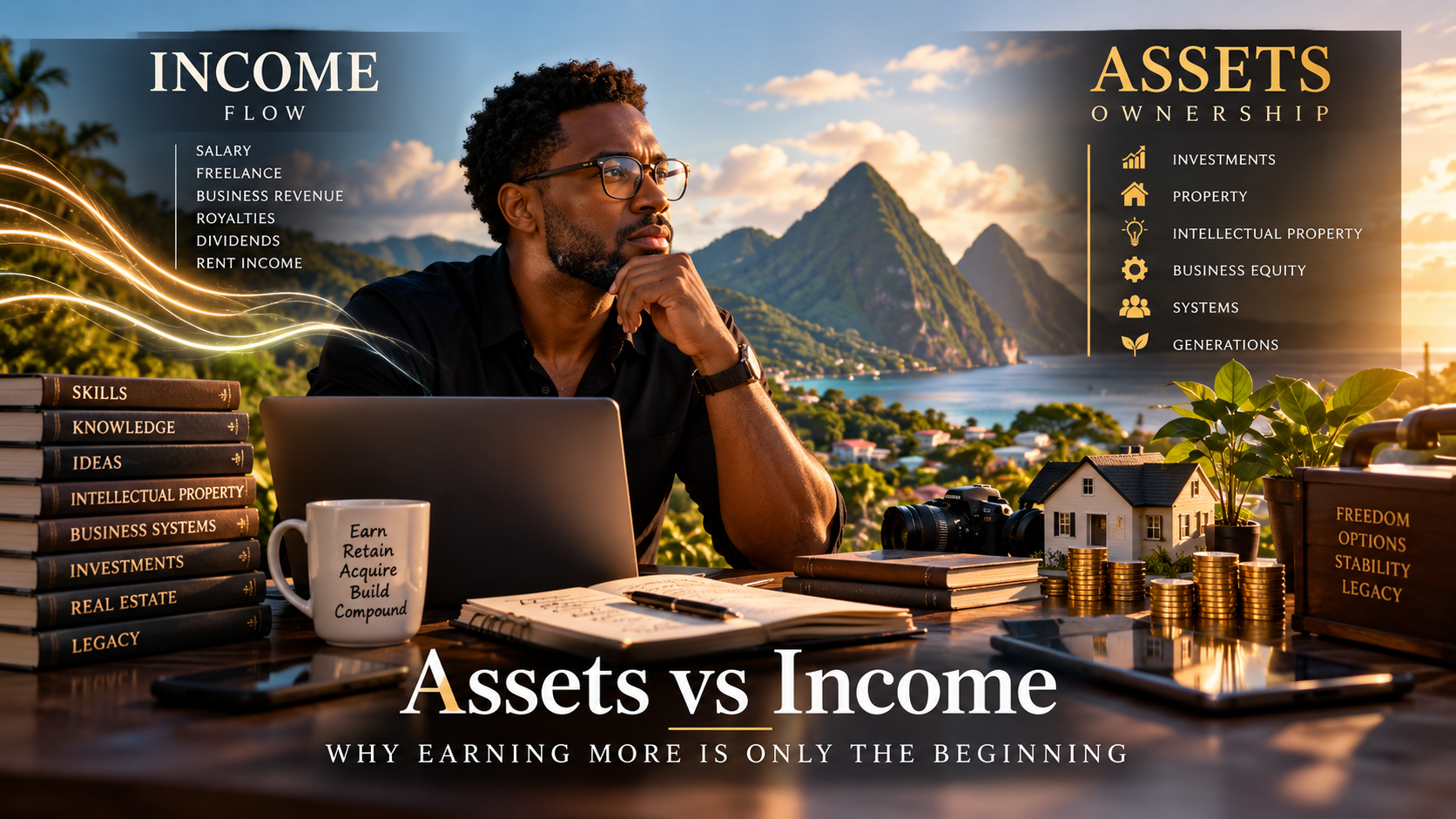
There is a moment in many people’s financial lives when the goal becomes simple:
Earn more.
Sometimes that is exactly the right goal.
More income can mean better housing, less anxiety around bills, more choices for your children, the ability to travel, access to better healthcare, room to help family, freedom from certain forms of debt and the dignity of not having every unexpected expense become a crisis.
We should not speak casually about income as though it does not matter.
It matters enormously.
But eventually another question appears.
What happens to the money after you earn it?
Because earning and building wealth are related, but they are not the same activity.
A person can earn considerably more than they did five years ago and still remain financially fragile.
Their house may be larger. Their car may be newer. Their holidays may be better. Their wardrobe may announce progress.
Yet if the income stops and almost everything stops with it, the financial structure underneath the lifestyle may not have changed nearly as much as the lifestyle itself.
This is where the conversation must move beyond income.
Not away from earning.
Beyond it.
Income Is Flow. Wealth Is Stock.
One of the clearest ways to understand the distinction is to think in terms of flow and stock.
Income is money flowing into your financial life over a period of time.
Salary. Freelance fees. Consulting revenue. Business earnings. Royalties. Rent received. Dividends.
These are forms of financial flow.
Wealth, by contrast, concerns what has accumulated.
Financial institutions and economists commonly describe net worth as the value of assets minus liabilities. The distinction matters because income and net worth do not necessarily move together.
Someone can have a high income and relatively little net worth.
Someone else can have a moderate current income while owning substantial assets accumulated over decades.
Income tells us something about what is arriving.
Assets and liabilities tell us something about what has been built underneath.
Income determines what passes through your hands. Assets help determine what remains, compounds, produces and can eventually operate beyond your direct labour.
The Question Is What Happens After You Earn It
Imagine two people whose incomes rise by roughly the same amount.
The first immediately expands life to consume the increase.
A more expensive vehicle. A larger monthly payment. More subscriptions. More expensive habits. More spending that quietly becomes the new definition of normal.
The second person improves their life too.
But some portion of the increase is deliberately retained.
Some strengthens cash reserves. Some reduces costly debt. Some acquires investments. Some helps build a business. Some purchases productive tools. Some may eventually acquire property or other assets appropriate to that person’s circumstances.
Years later, the two people may have earned similar amounts.
But they have not built the same financial life.
Earn → Retain → Acquire → Build → Compound
Earning is the beginning of the sequence.
It is not the entire sequence.
The Danger of Looking Wealthy
Morgan Housel explores a particularly useful distinction in The Psychology of Money: visible consumption and actual wealth are not the same thing.
Consumption is visible.
Wealth often is not.
You can see someone’s car. You cannot see their investment account.
You can see the holiday. You cannot see the emergency reserve.
You can see the house. You usually cannot see the mortgage balance.
You can see the designer clothing. You cannot see the investments that were never sacrificed to purchase it.
This makes wealth socially strange.
We often judge people’s financial success using evidence of what they have spent rather than what they have retained.
That does not mean expensive things are wrong.
Money is also for living.
There is nothing inherently virtuous about deprivation, just as there is nothing inherently foolish about enjoying what you have earned.
The more useful question is whether the lifestyle rests on something stronger than the next payment.
This connects directly with the deeper behavioural patterns explored in The Psychology of Money: How Identity Shapes Financial Decisions . Spending is rarely mathematics alone. Status, childhood experience, belonging, insecurity and our private definition of success can all participate in financial decisions.
Retaining Money Is Where Ownership Begins
Nearly a century ago, George S. Clason built The Richest Man in Babylon around a deceptively simple principle: a portion of what enters your hands should remain yours.
The language of the book belongs to another era.
The underlying principle does not.
If every dollar that enters your life already belongs to someone else, there is little left from which ownership can be built.
The landlord receives some. The bank receives some. The supermarket receives some. The utility company receives some. The streaming service receives some. The car company receives some. The restaurant receives some.
None of those transactions is automatically a mistake.
Life costs money.
But the portion that remains is the portion from which financial resilience and ownership can begin.
But “Save Ten Percent” Is Not a Moral Judgment
This is where personal finance advice often becomes too clean for real life.
Not everyone currently has the same capacity to retain income.
Someone whose earnings barely cover food, housing, transportation, childcare and family responsibilities does not have the same financial margin as someone earning far beyond their essential costs.
Telling both people to simply exercise more discipline confuses arithmetic with character.
There are moments when the most important financial strategy really is to increase income.
Develop a more valuable skill. Negotiate. Change employment. Build another revenue stream. Improve the economics of a business. Reduce high-cost debt.
Solve the income problem before pretending it is merely a budgeting problem.
The principle is not that everyone must save the same percentage.
The principle is that as financial margin increases, some of that margin eventually needs to become something more durable than consumption if wealth is the goal.
An Asset Is More Than Something You Bought
The word asset is often used loosely in personal finance.
It helps to be more precise.
In ordinary financial accounting, an asset is something of economic value that is owned or controlled.
That can include cash, investments, property, business interests and certain forms of intellectual property.
But not every asset behaves in the same way.
Some generate cash flow. Some may appreciate. Some preserve liquidity. Some provide strategic utility. Some can lose value. Some require considerable money to maintain. Some carry substantial risk.
This is why the popular idea that “an asset puts money in your pocket and a liability takes money out” can be useful as a teaching shortcut but should not be confused with a complete financial definition.
A house, for example, may be an asset on a balance sheet while simultaneously requiring mortgage payments, insurance, taxes and maintenance.
An investment is an asset even when it does not send cash into your account every month.
The real financial question is not simply:
Is this an asset?
It is also:
What role does this asset play in the structure I am trying to build?
The First Asset May Be Your Earning Power
Before many people acquire substantial financial assets, they build something economists sometimes call human capital.
Knowledge. Skill. Judgment. Experience. Reputation. Relationships. The capacity to solve increasingly valuable problems.
Developing yourself can dramatically increase the amount of value you are capable of creating.
But there is an important distinction.
Your skill may increase your income while still remaining inseparable from your labour.
If you must personally perform every hour of value creation, your earning capacity may be excellent while the system remains dependent on you.
That is why the next movement matters:
From skill toward ownership.
We explored that transition more deeply in From Skill to System: How to Build a Business Around What You Know .
Intellectual Property Can Become an Asset
This matters especially for writers, musicians, designers, educators, software builders, photographers, filmmakers and other creators.
A song is creative expression.
Rights attached to that song may also carry economic value.
A book contains ideas.
It may also become intellectual property capable of being sold, licensed, translated or adapted.
A framework may begin as something you use privately with clients.
Documented and developed properly, it may become part of a larger body of intellectual property.
A software product, trademark, design, photograph, course or archive can sometimes move knowledge from something that exists only inside the creator toward something identifiable, ownable and potentially transferable.
The World Intellectual Property Organization recognizes that intellectual property can carry economic value and may create benefits through commercial use, licensing or sale.
That does not mean every idea is automatically a valuable asset.
An idea nobody can identify, protect, distribute or derive economic value from may remain simply an idea.
The transformation requires structure.
What you know can produce income. What you structure and own may begin producing an asset.
A Business Can Produce Income Without Yet Becoming an Asset
This distinction is particularly important for entrepreneurs.
You can own a business that pays you well while still owning something that would struggle to exist without you.
You find the clients. You deliver the service. You solve every problem. You hold the relationships. You remember how everything works.
You are the sales department, production department, customer service department and institutional memory.
That business may provide excellent income.
There is nothing wrong with that.
But if the business cannot function, transfer knowledge, retain customers or create value without your constant intervention, much of its economic power may still be tied to your labour.
As systems emerge, the nature of the business begins to change.
Processes. Intellectual property. Brand equity. Distribution. Customer relationships. Recurring revenue. Documentation. Capable people. Institutional knowledge.
The business begins remembering what it has learned.
A business that depends entirely on your daily presence may provide income. A business with systems, intellectual property, processes and transferable value is beginning to behave more like an asset.
Ownership Looks Different in the Caribbean
The Caribbean adds its own history and realities to this conversation.
For many families, wealth has never existed only inside investment accounts.
It may be represented by land. A family home. A small business. Agricultural property. A house built gradually over many years. Money earned abroad and sent home. The education of a child who later becomes capable of supporting others.
These forms of wealth do not always fit neatly into imported personal-finance narratives.
Migration complicates the picture further.
A person may earn income in London, Toronto, New York or elsewhere while directing part of that income toward land, housing, family or enterprise in the Caribbean.
Remittances remain part of the economic reality of Caribbean societies, including Saint Lucia.
But ownership can also become complicated.
Family property may be valuable while being difficult to develop. Land can carry emotional meaning while ownership is divided among heirs. A house can represent decades of sacrifice while producing no income. A business can support several relatives while retaining little capital for expansion.
The lesson is not that one model of wealth should replace another.
It is that we should become more conscious of what we own, how it is structured, what value it produces, what obligations accompany it and whether it can be preserved across generations.
Creators Need an Asset Conversation Too
Caribbean creators in particular should pay attention to this.
We often celebrate the performance. The song. The painting. The design. The photograph. The book. The festival. The cultural moment.
But behind the creative expression is another set of questions.
Who owns the rights?
Who controls the masters?
Who owns the trademark?
Who can license the work?
Where is the archive?
What happens to the catalogue twenty years from now?
Can the intellectual property continue producing value after the initial moment of attention has passed?
Creative work can generate income.
Creative ownership can begin building something more durable.
Assets Buy Something Deeper Than Things
There is a point at which the conversation about assets stops being primarily about accumulation.
Assets can create margin.
And margin changes decisions.
A financial reserve can give you time to leave a harmful work environment.
Investments may eventually reduce dependence on employment income.
A well-structured business can give an owner options that self-employment alone may not.
Intellectual property can allow yesterday’s work to continue creating value tomorrow.
A debt-free or substantially owned home can alter the economics of later life.
None of these outcomes is guaranteed.
Assets carry risk. Markets fall. Businesses fail. Property requires maintenance. Intellectual property can become commercially irrelevant.
Wealth building is not the elimination of uncertainty.
But a stronger asset base can create something income alone may struggle to provide:
the ability to make some decisions without asking what the next paycheque requires.
That is why wealth eventually becomes a conversation about sovereignty.
Do Not Confuse Assets With Speculation
Once people understand that ownership matters, another danger appears.
The desire to acquire assets quickly.
This is where patience can disappear.
Every new market becomes an opportunity. Every rising price becomes proof. Every confident person online becomes a financial teacher.
But buying something because you hope someone else will soon pay more for it is not the same as understanding what you own.
Asset building requires due diligence.
Risk matters. Liquidity matters. Time horizon matters. Diversification matters. Debt matters. Fees matter. Legal ownership matters. Your own circumstances matter.
The purpose of moving from income toward assets is not to become more vulnerable to financial hype.
It is to become more deliberate about ownership.
The Real Shift Is From Consumption to Conversion
Perhaps the most useful question is not whether you should spend less.
It is what you are converting your income into.
Some income becomes survival.
It must.
Some becomes experience. Some becomes pleasure. Some becomes generosity. Some becomes education. Some becomes debt repayment. Some becomes security.
Some becomes ownership.
The goal is not to turn every dollar into an investment and postpone living indefinitely.
The goal is consciousness.
To know whether today’s income is merely passing through you or whether some portion of it is being converted into a stronger tomorrow.
Income gives you resources. Conversion determines what those resources become.
Eventually the Question Becomes Legacy
At first, assets provide security for you.
Eventually, if enough is built, another question becomes possible.
What happens after you?
Can the business transfer? Can the intellectual property continue? Is ownership legally clear? Does the next generation know what exists? Is knowledge documented? Are there structures capable of preserving what took decades to build?
That is where asset building begins meeting legacy building.
It is also where our earlier reflection, How to Build Something That Can Outlive You , becomes relevant.
Because ownership without transferability can still disappear within a generation.
Earning More Is Still Worth Pursuing
None of this is an argument against ambition.
Earn more.
Build the company.
Improve your skill.
Negotiate the salary.
Create another revenue stream.
Charge properly for valuable work.
Expand what you are capable of producing.
Income matters.
Especially when there is not enough of it.
But as income grows, allow the question to mature.
Do not ask only:
How much am I earning?
Begin asking:
What am I building and owning with what I earn?
Because income can change the quality of the present.
Assets can begin changing the structure of the future.
What Remains?
Imagine looking back over the next ten years.
Thousands of hours worked. Salaries received. Invoices paid. Businesses built. Projects completed. Money flowing in and flowing out.
At the end of those ten years, what remains?
Not only in the bank.
What do you own?
What has compounded?
What produces?
What protects?
What gives you options?
What could continue without your next hour of labour?
What could eventually be transferred?
What exists because you worked that would still exist if you stopped working tomorrow?
These are different questions from income.
They are questions of ownership.
And eventually, questions of legacy.
Earning more can change your standard of living. What you build and own with what you earn can change the structure of your life.
A Question Worth Carrying
The next time your income increases, celebrate it.
You worked for that progress.
Then ask one more question before your lifestyle expands to absorb all of it:
What portion of this increase can become something I own?
Not because life should become an endless exercise in accumulation.
But because ownership can create choices that income alone cannot guarantee.
Build Beyond the Income
There comes a stage when earning more is no longer the only question.
The deeper work becomes building structures, intellectual property, businesses, relationships and assets capable of carrying value forward.
For those thinking seriously about ownership, meaningful work and what they are building beyond themselves, the Legacy Builders Network exists as a space for that journey.
Books for Deeper Study
The Psychology of Money — Morgan Housel
A thoughtful exploration of financial behaviour, risk, compounding, freedom and the often invisible difference between spending money and accumulating wealth.
The Richest Man in Babylon — George S. Clason
A classic collection of financial parables exploring the principles of retaining part of what you earn, controlling expenditure and gradually putting accumulated capital to work.
Affiliate Disclosure: Some book links on this page are affiliate links. If you purchase through them, ThaPoetic1 may earn a small commission at no additional cost to you.
Sources & Further Reading
Federal Reserve — Changes in U.S. Family Finances from 2019 to 2022
World Intellectual Property Organization — Valuing Intellectual Property Assets
[…] explored this more directly in Assets vs Income: Why Earning More Is Only the Beginning. Earning is important, but what we retain, own, build and transfer eventually becomes part of the […]