Self-Mastery: How to Become the Architect of Your Own Life
Self-mastery is not absolute control. It is learning to govern your attention, habits, impulses and choices while working intelligently with the realities you cannot control. Drawing on Robert Greene, James Clear, Viktor Frankl and Marcus Aurelius, this essay explores what it means to become the architect of your own life.
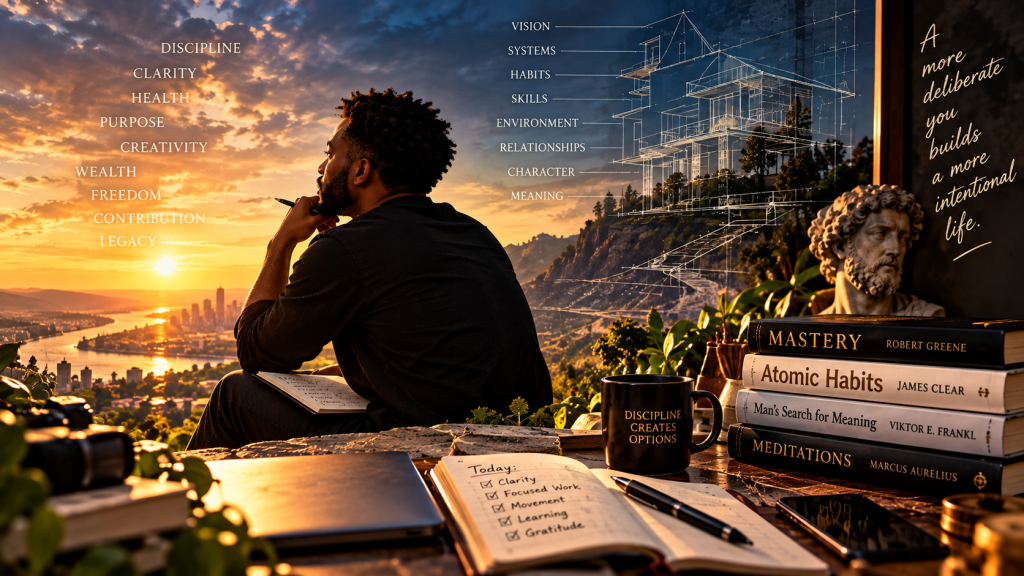

Every life is being designed.
The question is whether we are participating consciously in the design.
Long before we begin speaking about purpose, discipline or personal development, forces are already shaping us.
Family.
Culture.
Fear.
Desire.
Education.
Religion.
Social expectations.
Economic circumstances.
Childhood experiences.
The people whose approval we learned to seek.
And now, increasingly, algorithms designed to keep our attention long enough to turn it into revenue.
None of this means we are powerless.
It means we do not begin from a blank page.
To become the architect of your own life is therefore not to imagine that you can control everything that happens to you.
You cannot.
It is to become conscious enough of the forces shaping you that they no longer make every important decision on your behalf.
That is where self-mastery begins.
The Architect Does Not Control the Terrain
The architectural metaphor needs one important correction.
An architect does not create the land.
There is already terrain.
A slope.
A climate.
Boundaries.
Available materials.
Existing structures.
Building regulations.
A budget.
Perhaps damage left behind by whoever occupied the land before.
The architect’s task is not to pretend those conditions do not exist.
It is to understand them well enough to design intelligently within them.
Human life is similar.
We do not choose where we are born.
We do not choose every circumstance of childhood.
We do not choose every loss.
Every economic condition.
Every betrayal.
Every limitation of the body.
Every historical condition into which we arrive.
But within reality there remains a profound question:
What will I construct with what is actually here?
Self-mastery lives somewhere between two illusions.
One says we control everything.
The other says we control nothing.
Neither is sufficient.
You Cannot Master What You Refuse to Observe
Most people begin self-improvement by trying to change themselves.
There is an earlier task.
Observe yourself.
Notice what makes you defensive.
Notice what you avoid.
Notice what you repeatedly postpone.
Notice whose approval can change your decisions.
Notice what happens when you are bored.
Notice what you reach for when you feel uncomfortable.
Notice which kinds of criticism disturb you disproportionately.
Notice the promises you repeatedly make to yourself and then quietly break.
This kind of observation is not self-condemnation.
It is reconnaissance.
An architect surveys the site before drawing the building.
Self-mastery asks us to do something similar.
Your Attention Is Building Your Life
We tend to think about life in terms of large decisions.
Which career?
Which relationship?
Which city?
Which business?
But a life is also constructed through thousands of smaller allocations of attention.
What receives your attention repeatedly begins occupying psychological territory.
What you watch.
What you read.
Who you listen to.
What outrages you.
What you rehearse mentally.
What you compare yourself against.
What you allow to interrupt you.
Attention is not merely something you have.
It is something through which your inner world is continually being constructed.
This makes attention one of the central territories of self-mastery.
If another person, platform or algorithm can reliably determine what you think about every spare moment, part of the architecture of your inner life has effectively been outsourced.
Reclaiming attention does not require disappearing from modern life.
It requires becoming less available to everything.

Freedom Is Not the Same as Obedience to Impulse
Modern culture often describes freedom as the ability to do what we want.
But what happens when what we want changes every fifteen minutes?
I want to become healthier.
I also want the immediate comfort of avoiding exercise.
I want to build a business.
I also want relief from the discomfort of doing difficult work.
I want financial stability.
I also want the status attached to buying something I do not need.
I want peace.
I also want to win this argument.
Which desire represents freedom?
Self-mastery does not require the destruction of desire.
It requires the ability to experience an impulse without automatically converting that impulse into action.
Discomfort can influence me without commanding me.
That is a different kind of freedom.
Robert Greene: Mastery Requires Apprenticeship
Robert Greene’s Mastery is useful here because it refuses one of the more seductive fantasies of modern ambition: that mastery can somehow be separated from time.
We want the visible result.
The authority.
The freedom.
The recognition.
The ability to move intuitively through a field.
But genuine mastery usually has an apprenticeship beneath it.
Greene writes:
“The future belongs to those who learn more skills and combine them in creative ways.”
The larger lesson is not simply to collect skills.
It is to submit yourself to reality long enough for reality to teach you.
You practice.
Fail.
Observe.
Correct.
Return.
Eventually what once required enormous conscious effort begins becoming intuitive.
The musician hears more.
The writer sees the weak sentence.
The entrepreneur recognizes a pattern.
The craftsperson feels what is wrong before being able to fully explain it.
Mastery is not merely knowing more.
It is knowledge becoming embodied.
This is one reason constant novelty can become an obstacle.
If we leave every path the moment the excitement disappears, we may repeatedly experience beginnings without ever discovering depth.
Explore Robert Greene’s Mastery →
The Person You Become Is Hidden Inside Repetition
James Clear approaches a related question from the level of habit.
In Atomic Habits, one of his central ideas is that lasting behavioural change becomes more powerful when connected to identity rather than merely outcomes.
His concise formulation is:
“Every action you take is a vote for the type of person you wish to become.”
This does not mean one action defines you.
It means repetition leaves evidence.
We often imagine identity as something discovered through introspection alone.
But part of identity is behavioural.
The person who writes repeatedly begins accumulating evidence that they are a writer.
The person who keeps promises to themselves accumulates evidence of self-trust.
The person who repeatedly avoids difficult conversations also accumulates evidence.
So does the person who abandons every project after the first wave of enthusiasm disappears.
The architecture of a life is not drawn only in our intentions.
It is visible in repetition.
Explore James Clear’s Atomic Habits →
Do Not Make Willpower Carry the Entire Building
If you are serious about changing your life, do not rely exclusively on becoming stronger in the presence of every temptation.
Change the environment where possible.
If the phone destroys your concentration, move it.
If certain relationships continually pull you toward behaviour you are trying to leave behind, examine the amount of access those relationships have.
If you want to read more, make books easier to reach.
If you want to create in the morning, prepare the space the night before.
If you want to spend less impulsively, remove some of the mechanisms that make spending frictionless.
Good architecture anticipates human behaviour.
Your personal systems should do the same.
Discipline matters.
But intelligent design reduces the number of moments when discipline must rescue you.
Viktor Frankl and the Freedom That Remains
There are circumstances in which the language of designing your life can become offensively simplistic.
Human beings encounter illness.
Grief.
Oppression.
Poverty.
War.
Loss.
Events no amount of visualization could have prevented.
Viktor Frankl’s Man’s Search for Meaning matters precisely because his thought emerged from conditions in which external freedom had been brutally restricted.
Frankl’s work does not give us permission to romanticize suffering.
It asks a more difficult question about what forms of human agency may remain even when circumstances become severe.
One of his enduring formulations is:
“When we are no longer able to change a situation, we are challenged to change ourselves.”
There are times to change the situation.
Leave.
Resist.
Build.
Negotiate.
Organize.
Seek help.
Create another option.
But there are also realities that cannot immediately be changed.
Self-mastery asks what kind of response remains available there.
Not because response makes injustice acceptable.
But because surrendering every remaining part of ourselves to what happened gives circumstance more territory than it already took.
Explore Viktor Frankl’s Man’s Search for Meaning →
Marcus Aurelius: Govern the Judgment
Stoic philosophy offers another important layer.
Marcus Aurelius was emperor of Rome, yet much of Meditations reads less like the reflections of a ruler trying to control the world and more like a man repeatedly reminding himself to govern his own judgments.
He writes:
“You have power over your mind—not outside events.”
The popular version of Stoicism is sometimes reduced to emotional hardness.
But self-command is not the same as becoming numb.
The more useful distinction is between the event and the judgment we add to the event.
Someone criticizes your work.
That is an event.
“I am a failure and everyone can see it.”
That is an interpretation.
A plan changes unexpectedly.
That is an event.
“Everything is ruined.”
That is an interpretation.
The interpretation may arise immediately.
Self-mastery creates enough consciousness to examine it before building a house inside it.
Explore Marcus Aurelius’s Meditations →

Self-Mastery Is Not Self-Punishment
There is a version of discipline that is actually hostility toward the self.
It treats exhaustion as weakness.
Emotion as inconvenience.
Rest as laziness.
Failure as evidence of worthlessness.
This can look disciplined from the outside while being deeply disordered within.
A person may become highly productive while remaining incapable of peace.
They may control their schedule while being controlled by the need to prove themselves.
They may achieve everything they once wanted and discover that the person doing the achieving is exhausted, frightened and unable to stop.
That is not mastery.
Self-mastery requires firmness.
But firmness without understanding easily becomes violence turned inward.
The goal is not to dominate yourself.
It is to become capable of governing yourself.
Learn to Be Alone Without Immediately Escaping
Solitude has become strangely difficult.
We can now fill almost every empty moment.
Waiting in line.
Sitting in traffic.
Eating alone.
Walking.
Lying in bed.
There is always something available to watch, scroll, hear or answer.
This convenience has a cost.
If every moment of silence is immediately filled, some parts of ourselves become difficult to hear.
Boredom can reveal what we habitually escape.
Silence can reveal what constant stimulation was covering.
Journaling can expose recurring thoughts.
Meditation can show us just how little control we initially have over attention.
Solitude can reveal whether the life we are building actually feels like ours when nobody is watching.
Choose Standards Before Emotion Chooses for You
One of the practical advantages of knowing what you value is that some decisions can be made before the emotional moment arrives.
You can decide what kind of work you will not accept.
What behaviour you will not tolerate in a relationship.
What financial boundaries you intend to maintain.
What you will not sacrifice merely for status.
What kind of person you want to be when angry.
What kind of work deserves your best attention.
What you are unwilling to become in pursuit of success.
Standards reduce negotiation with your weakest moments.
They do not make difficult choices painless.
They make the architecture clearer.
Your Environment Is Also an Architect
Self-mastery is often discussed as though the individual exists alone.
We do not.
The people around us shape what feels normal.
Our environment reinforces certain behaviours and makes others more difficult.
A culture can reward one definition of success so consistently that we stop realizing it is only one definition.
A friendship group can normalize habits we would question in another environment.
A workplace can train us to mistake constant urgency for importance.
A digital environment can make comparison feel like ordinary consciousness.
Becoming the architect of your own life therefore includes becoming more deliberate about what is allowed to participate in the design.
Who has access to your attention?
Whose opinions carry authority?
What environments make your best qualities easier to express?
Which environments continually awaken versions of yourself you are trying to outgrow?
We cannot control every environment.
But where choice exists, environment is one of the most powerful forms of architecture available to us.
Mastery Is a Direction, Not a Finish Line
There is a final danger in the language of self-mastery.
It can suggest that one day we arrive.
Fully disciplined.
Fully conscious.
Free from contradiction.
Immune to fear.
Beyond temptation.
Permanently aligned.
Human beings do not seem to work that way.
Life changes.
Success reveals new weaknesses.
Relationships reveal hidden patterns.
Responsibility tests capacities that solitude never touched.
Grief rearranges priorities.
Age changes the questions.
New environments reveal parts of us that old environments never activated.
Mastery is therefore less like finishing a building and more like becoming increasingly capable of inhabiting, repairing and redesigning the structure as life changes.
Your Life Is Being Built Either Way
Look at your present habits.
Your relationships.
Your calendar.
Your spending.
Your attention.
Your unfinished work.
Your repeated conversations.
Your private standards.
Your digital environment.
The promises you keep.
The promises you repeatedly postpone.
Imagine that these things are not random fragments.
Imagine they are architectural drawings.
What kind of life are they currently constructing?
Not the life you say you want.
Not the life on the vision board.
Not the life you intend to begin when circumstances become perfect.
The life being built by what you repeatedly do now.
That question may be uncomfortable.
It is also useful.
Because architecture can change.
A wall can be moved.
A foundation can be strengthened.
A room can be repurposed.
Something unstable can be rebuilt.
Something inherited can be examined rather than automatically preserved.
And something new can begin from the materials already available.
Self-mastery is not absolute control.
It is conscious participation.
The willingness to see yourself clearly.
To govern what can be governed.
To accept what cannot presently be changed without confusing acceptance with surrender.
To train attention.
To build better habits.
To choose standards.
To remain an apprentice long enough to become capable.
And to keep returning to the work of becoming someone increasingly able to direct their own life.
If your present choices were architectural drawings, would you willingly live in the life they are constructing?
Books for Deeper Study
Self-mastery is too large a subject for a single essay. These four books approach the work from different directions and have helped shape parts of the conversation above.
Affiliate Disclosure: Some links in this section are affiliate links. If you purchase through them, ThaPoetic1 may earn a small commission at no additional cost to you.
Mastery — Robert Greene
Read this for the long arc: apprenticeship, skill acquisition, depth, mentors, creative independence and the patience required to become genuinely capable at meaningful work.
Atomic Habits — James Clear
Read this for the daily architecture: how identity, environment, repetition and small systems influence whether our intentions become behaviour.
Man’s Search for Meaning — Viktor E. Frankl
Read this for meaning, responsibility and the difficult question of what forms of inner freedom can remain when external circumstances are not ours to choose.
Explore Man’s Search for Meaning →
Meditations — Marcus Aurelius
Read this slowly rather than as a modern productivity manual. It is a private record of someone repeatedly returning to questions of judgment, duty, attention, character and self-command.
When the Architecture Needs to Change
Sometimes the difficulty is not that you lack ambition.
You may simply have reached a point where the life you built for an earlier version of yourself no longer fits the person you are becoming.
If you are navigating that kind of creative or personal realignment, a Creative Alignment Session offers a space to step outside the noise, examine the architecture honestly and clarify what the next chapter should be built around.
The work of self-mastery is not becoming someone who controls everything.
It is becoming someone increasingly capable of choosing what deserves to shape the life being built.