The Ultimate Skool Review (2026): Honest Pros, Cons & Pricing
ThaPoetic1 Review
Skool is not just another course platform. It is a community-first learning environment for creators who want to turn knowledge into structure, accountability, and recurring income. But it is not perfect — and it is not for everyone.

Why Skool Matters Now
Online education has changed.
For years, creators were told to build courses. Record the lessons. Upload the videos. Sell the program. Let students work through the material on their own.
But many creators eventually discovered the same problem:
Information alone does not create transformation.
Students buy courses and never finish them. Facebook Groups become noisy and distracting. Discord servers get chaotic. Traditional course platforms often feel like digital filing cabinets — organized, but lifeless.
That is the gap Skool is trying to solve.
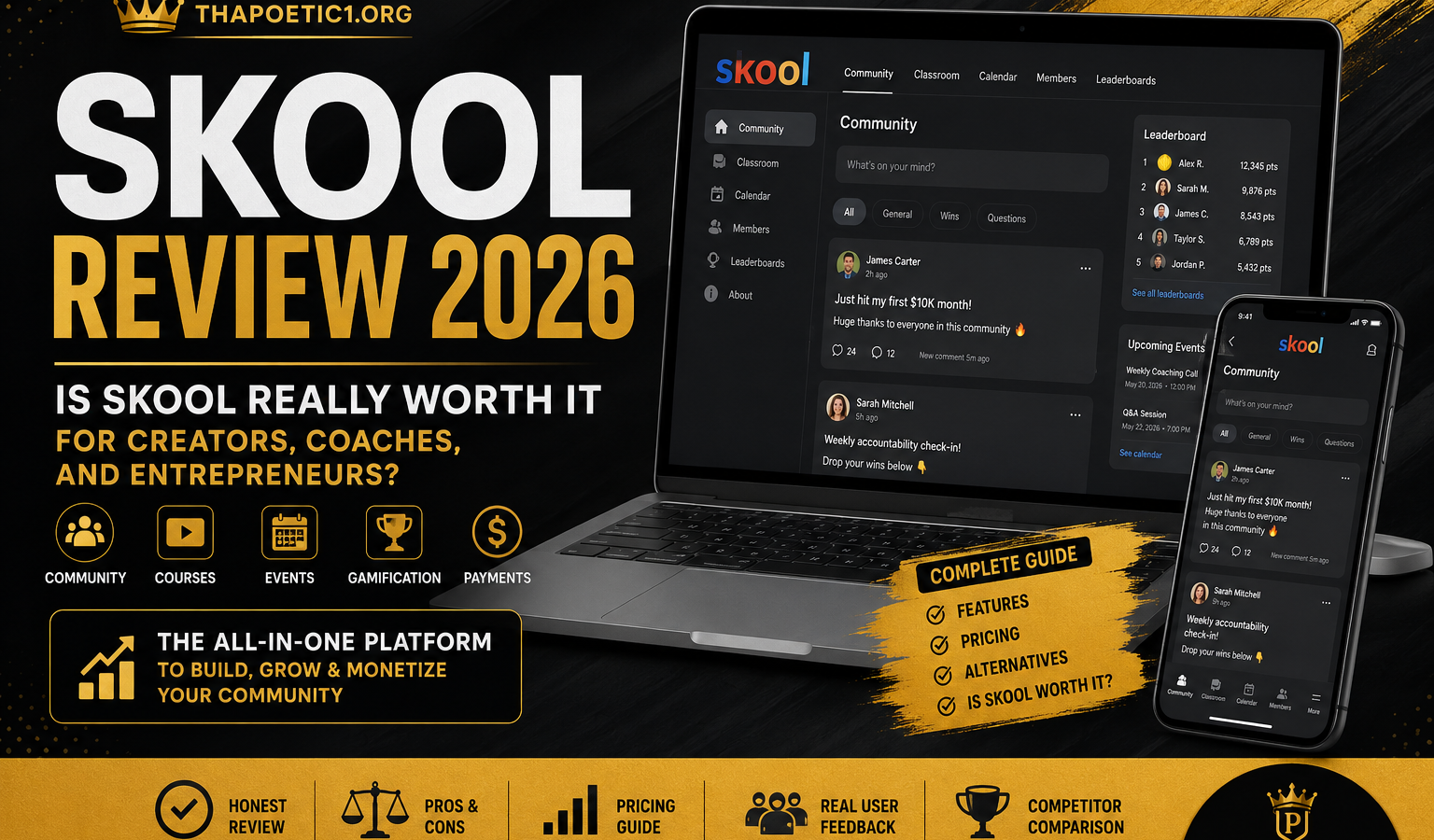
Skool brings together community discussion, online courses, events, direct messaging, gamification, and payments in one place. The platform is designed for creators, coaches, consultants, educators, artists, and entrepreneurs who want to build communities around what they know.
This makes Skool especially relevant to the ThaPoetic1 ecosystem because our work is built around clarity, structured learning, disciplined action, conscious creation, and legacy. A platform like Skool matters only if it helps knowledge become practice.
The world does not need more content. It needs better containers for transformation.
What Is Skool?
Skool is an online community platform that combines several creator tools into one simple environment.
Inside a Skool group, members can usually access:
- A community feed for posts and discussion
- A classroom for courses, resources, and structured lessons
- A calendar for calls, events, and live sessions
- Member profiles and direct messaging
- Points, levels, and leaderboards
- Paid memberships or one-time course purchases
The important distinction is that Skool is not only a course platform. It is a learning community platform.
A traditional course platform is built around content delivery.
Skool is built around participation.

Who Founded Skool?
Skool was founded in 2019 by Sam Ovens and Daniel Kang. Skool’s official About page lists Sam Ovens as CEO, Daniel Kang as CTO, and notes that Alex Hormozi partnered with Skool in 2024 through The Skool Games.
This explains part of the platform’s identity. Skool is not positioned as quiet enterprise software. It has a strong creator-business culture around it, especially in coaching, consulting, entrepreneurship, and online education.
That can be a strength or a turnoff depending on the user.
If you are building a paid community, the business energy around Skool may be useful. If you are looking for a purely academic LMS, the culture may feel too entrepreneurial.
The software itself, however, can serve many types of creators: educators, authors, musicians, artists, faith communities, productivity coaches, language teachers, fitness instructors, business mentors, and personal development leaders.
Skool Pricing in 2026
Skool currently lists two public plans: Hobby and Pro.
| Plan | Monthly Price | Best For | Transaction Fee |
|---|---|---|---|
| Hobby | $9/month | Testing an idea, starting small, validating demand | 10% + 30¢ per transaction |
| Pro | $99/month | Paid communities, active monetization, serious creators | 2.9% + 30¢ up to $899; higher for transactions above $900 |
The Hobby plan is attractive because it lowers the barrier to entry. A creator can test a community idea without committing to a large software cost.
But transaction fees matter.
If your community starts generating consistent revenue, the Pro plan will often make more sense. The lower transaction fee can quickly offset the higher subscription price.
Skool’s Core Features
1. Community Feed
The community feed is where members post questions, share wins, comment, reply, and interact.
This is one of Skool’s biggest advantages over traditional course platforms. Instead of isolating students inside video modules, Skool makes learning visible and social.
That matters because community creates momentum.
When members see other people asking questions, making progress, and sharing results, they are more likely to stay active.
2. Classroom
The Classroom is where creators organize lessons, guides, resources, templates, and courses.
This does not have to be a traditional course. It can be a resource library, implementation guide, training vault, challenge curriculum, spiritual study path, writing program, coaching framework, or step-by-step business system.

Skool now supports native video uploads, which makes it more useful as a course platform than older reviews may suggest.
Still, it is not an advanced academic LMS. If you need graded assignments, certificates, compliance tracking, or complex reporting, Skool may be too lightweight.
3. Calendar and Events
The calendar is where creators schedule calls, workshops, webinars, accountability sessions, and recurring events.
This is crucial because a community needs rhythm.
A strong Skool community might operate like this:
- Monday: accountability thread
- Tuesday: training drop
- Wednesday: live Q&A call
- Thursday: implementation discussion
- Friday: wins and reflection
That rhythm turns a group into an environment.

4. Gamification: Points, Levels, and Leaderboards
Skool’s points and level system rewards participation. Members earn points when others like their posts, comments, and replies.
This can increase engagement because it gives members visible progress.
Creators can also use levels to unlock courses or resources, which encourages members to contribute before consuming everything passively.
Used well, gamification rewards useful participation. Used poorly, it can create shallow posting.
The difference depends on community leadership.
5. Payments
Skool supports paid memberships and one-time course purchases. This allows creators to build recurring revenue around education and community.
For creators trying to reach $5,000/month, the math is straightforward:
| Price | Clients / Members Needed | Monthly Revenue |
|---|---|---|
| $50/month | 100 members | $5,000/month |
| $100/month | 50 members | $5,000/month |
| $250/month | 20 members | $5,000/month |
| $500/month | 10 members | $5,000/month |
The platform will not create the revenue by itself.
The offer still matters.
The audience still matters.
The result still matters.
But Skool can provide the container where delivery happens.
Real Public Feedback: What Users Are Saying
Public feedback on Skool is mixed in the way most fast-growing platforms are mixed.
Positive users tend to praise Skool for being cleaner than Facebook Groups, simpler than Discord, and easier to use than many traditional course platforms.
Common praise includes:
- Clean interface
- Focused community experience
- Simple course delivery
- Strong engagement tools
- Better learning environment than Facebook Groups
- Useful for paid memberships
Negative users tend to mention mobile app issues, upload problems, limited customization, search/navigation frustrations, and skepticism around the “make money online” culture surrounding some communities.
Common criticism includes:
- Limited branding control
- Not enough advanced marketing tools
- App glitches for some users
- High transaction fee on Hobby plan
- Some communities feel hype-driven
This distinction matters:
Skool the software is simple and useful.
Skool the ecosystem can feel intense depending on which communities you encounter.
A serious educator can build something meaningful on Skool. A shallow marketer can also use it to sell empty promises.
The platform does not determine the integrity of the offer.
The creator does.
The Honest Pros and Cons
| Pros | Cons |
|---|---|
| Very easy to use | Limited design customization |
| Strong community engagement | Not a full marketing platform |
| Courses and community live together | Transaction fees can matter |
| Great for beginner creators | Not ideal for advanced LMS needs |
| Native video hosting | Some mobile reviews are mixed |
| Built-in payments | Culture can feel hype-driven in some circles |
Skool vs Alternatives

| Platform | Best For | Where It Wins | Where It Falls Short |
|---|---|---|---|
| Skool | Community-first education | Simplicity, engagement, courses + community | Limited customization and advanced marketing |
| Circle | Professional branded communities | Customization, polished community spaces | Can feel more complex |
| Kajabi | All-in-one course businesses | Funnels, emails, websites, offers | Community is not as native-feeling as Skool |
| Mighty Networks | Large branded networks | Community, events, app options | Can feel heavier to manage |
| Discord | Real-time chat communities | Fast conversation, free/low-cost setup | Can become chaotic and hard to structure |
| Facebook Groups | Free audience communities | Low barrier, people already use Facebook | Distracting, algorithmic, less premium |
Who Should Use Skool?
Skool is a strong fit if you want to build around community, education, and implementation.
It works well for:
- Coaches
- Consultants
- Educators
- Authors
- Writers
- Artists
- Musicians
- Fitness instructors
- Faith leaders
- Personal development teachers
- Entrepreneurs
- Mastermind leaders
- Challenge hosts
The better question is not “Do I have a course?”
The better question is:
Can I help a specific group of people make progress together?
If yes, Skool may be a strong fit.

Who Should Not Use Skool?
Skool may not be the best choice if you need:
- Advanced website design
- Full sales funnels
- Complex email automation
- Academic LMS features
- Detailed student analytics
- Enterprise reporting
- A fully white-labeled app
- Deep brand customization
Skool is not trying to be everything.
That is part of why it works.
But it also means some businesses will need additional tools.
Why I’m Personally Interested in Skool
ThaPoetic1 is built around a specific idea:
Clarity becomes powerful when it turns into structure.
The work here is not merely about reading inspiring thoughts. It is about building a living ecosystem for clarity, discipline, conscious prosperity, personal development, and legacy.
That is why Skool is worth paying attention to.
It creates a practical classroom environment where ideas can become lessons, conversations, calls, assignments, community discussions, and implementation challenges.
For creators, that matters.
A philosopher can build a school.
A writer can build a reader community.
A musician can teach craft.
A coach can create accountability.
An entrepreneur can build a paid network.
An educator can organize learning beyond scattered social media posts.
That is the real opportunity.
Final Verdict: Is Skool Worth It in 2026?
Final Score: 8.9 / 10
Skool is worth it if you want a simple, community-first platform for teaching, coaching, accountability, and paid memberships.
It is not worth it if you need a full marketing suite, deep customization, or advanced academic LMS tools.
Skool’s biggest strength is focus.
It gives creators one clean place to host discussion, lessons, calls, and member interaction.
Its biggest weakness is also focus.
It does not try to replace every business tool.
For many creators, that simplicity is exactly the point.
FAQ
Is Skool legit?
Yes. Skool is a real community and course platform used by creators, coaches, educators, and entrepreneurs. Like any platform, the quality of the experience depends heavily on the community owner.
Is Skool free?
Some Skool communities are free to join, but creating and operating your own Skool group typically requires a paid plan.
Can you make money on Skool?
Yes, creators can charge for memberships and courses. However, Skool does not guarantee income. Your result depends on your offer, audience, pricing, marketing, and delivery.
Is Skool better than Kajabi?
Skool is better for community-first learning. Kajabi is stronger as an all-in-one marketing and course business platform.
Is Skool better than Facebook Groups?
For paid education communities, Skool is usually cleaner and less distracting. Facebook Groups are easier to start for free, but they are less focused and less premium.
Who is Skool best for?
Skool is best for creators who want to teach, lead, coach, host calls, organize resources, and build a community around a specific outcome.
Start Building Your Classroom
If you have knowledge that can help people grow, Skool gives you a place to organize it, teach it, and build a community around it.
You do not need to be famous. You need a clear outcome, a specific audience, and the willingness to help people make progress.
Sources and Further Reading
Skool About Page
Skool Pricing
Skool Payments FAQ
Skool Classroom Help
Skool Video Upload Help
Skool iOS App Reviews
Skool Android App Reviews

Founder of ThaPoetic1
I Help Others Build Clarity, Wealth & Legacy ➜ ThaPoetic1.org
🧠 Modern Philosophy | 📚 Personal Development 🌱
- Daneille Louis

- Daneille Louis
Where philosophy becomes practice.
Legacy Builders Network is the official classroom of the ThaPoetic1 ecosystem — where courses, guided frameworks, implementation challenges, and community support turn reflection into action.
Enter The Classroom → Join The Newsletter