Productivity Is Not the Same as Being Busy
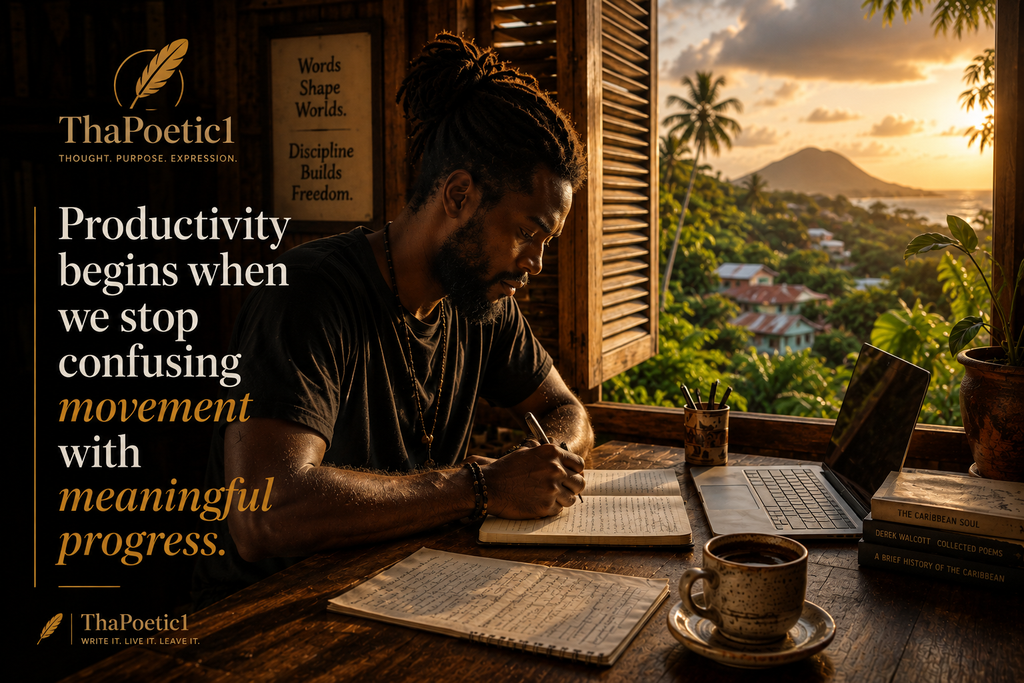
We have become remarkably good at being busy.
There is always another message to answer, another notification waiting, another email that deserves attention, another task that can be moved from one column to another. We wake up and enter the machinery almost immediately. Before the mind has had an opportunity to ask what the day is actually for, the world has already begun making demands upon it.
And because activity is visible, we often mistake it for progress.
A person with a crowded calendar appears productive. A person who answers messages quickly appears responsible. Someone who works late into the night appears committed. We have learned to associate exhaustion with seriousness, busyness with importance, and constant availability with value.
But there is a quieter question beneath all of this.
What are we actually producing?
Not merely what did we complete today, but what did our attention create? What did our energy move forward? What became more meaningful because we were present for it?
These questions matter because productivity is not ultimately about how much we can force ourselves to do.
It is about what we decide is worthy of our limited life.
The Problem With Modern Productivity
Much of the modern conversation around productivity begins with efficiency.
How can you answer emails faster? How can you wake up earlier? How can you fit more tasks into the day? How can you automate more? How can you optimize your morning?
These questions are not inherently wrong.
Efficiency has its place. Discipline matters. Organization matters. Learning how to work intelligently can create tremendous freedom.
But efficiency without direction can become a very sophisticated form of waste.
You can become extremely efficient at moving toward something that does not matter.
You can optimize a life you never consciously chose.
That is one of the contradictions of modern productivity culture. We are taught how to manage our time before we are encouraged to understand its value.
But time is not merely a resource to be managed.
Time is life.
Every hour you spend belongs to a life that cannot be repeated.
That changes the question.
Instead of asking only, “How can I get more done?”
We might ask:
“Is this worth doing at all?”
Productivity and the Creative Life
For artists, writers, musicians, designers, entrepreneurs, and independent thinkers, productivity has another dimension.
Creative work does not always behave like industrial work.
A factory can measure output by units produced. Creative life is more mysterious.
A writer may spend three hours staring at a page and emerge with one paragraph that changes the direction of an entire book.
A musician may spend an afternoon playing the same progression repeatedly before discovering something that could not have been found through efficiency alone.
An entrepreneur may spend weeks thinking about a problem before making one decision that changes the trajectory of the business.
From the outside, very little appears to have happened.
But inwardly, something was moving.
This is why creative productivity requires us to develop a different relationship with time.
Some of the most important work happens before the visible work appears.
Thinking is work.
Reading is work.
Walking can be work.
Observing is work.
Rest can be work when it restores the mind that must eventually create.
The danger is that a culture obsessed with visible output begins to make invisible work feel illegitimate.
We start believing that if we cannot point to something completed, we accomplished nothing.
But human beings are not machines.
Creation has seasons.
The Difference Between Activity and Fruitfulness
There is a difference between being active and being fruitful.
Activity asks:
“What am I doing?”
Fruitfulness asks:
“What is this producing?”
The distinction is subtle but profound.
You can spend an entire day answering other people’s questions and never address the question your own life has been asking you.
You can maintain ten projects and advance none of them.
You can consume endless information and produce very little understanding.
You can be available to everyone while becoming increasingly unavailable to yourself.
Busyness can therefore become a kind of camouflage.
It can protect us from the uncomfortable silence in which we might discover that we need to change direction.
Sometimes we stay busy because stillness would force us to confront what we have been avoiding.
The empty calendar can be frightening.
The quiet room can be frightening.
The unfinished dream can be frightening.
So we fill the space.
And then we call the fullness productivity.
Attention Is the Real Currency
Perhaps the deepest productivity question is not about time at all.
It is about attention.
Time passes whether we direct it or not.
Attention is different.
Attention is the portion of consciousness we choose—or allow—to place somewhere.
And in the digital age, attention has become contested territory.
Every platform wants it.
Every notification interrupts it.
Every algorithm studies it.
Every advertisement attempts to redirect it.
The modern person may technically have eight hours available for meaningful work while possessing only fragments of uninterrupted attention.
This matters because deep work requires depth of presence.
You cannot continuously divide your mind and expect the quality of your thinking to remain untouched.
Something is lost in constant switching.
The mind becomes accustomed to interruption.
Silence begins to feel uncomfortable.
Concentration becomes something we have to relearn.
For creatives especially, protecting attention is not a luxury.
It is part of the work.
Productivity and Sovereignty
There is also a deeper connection between productivity and personal sovereignty.
Sovereignty is not simply independence.
It is the capacity to participate consciously in the direction of your own life.
If everyone else can determine what deserves your attention, then your calendar may be full while your life remains strangely empty.
This is why saying no can be productive.
Not because refusal is inherently virtuous, but because every yes has a cost.
When you say yes to something, you are not only giving away time.
You are giving away a portion of your attention, your energy, and your possibility.
This becomes especially important for people building something of their own.
A creative practice.
A business.
A body of writing.
A community.
A family.
A legacy.
Meaningful work requires the courage to protect what has not yet become visible.
The world will always offer you something more urgent.
Your responsibility is to determine whether urgency deserves authority.
Rest Is Not the Opposite of Productivity
We have inherited an uncomfortable idea that rest must be earned.
Work first.
Then rest.
Produce enough.
Then recover.
Prove your worth.
Then breathe.
But this relationship with rest eventually turns the human being against the human body.
Rest is not a reward for being useful.
It is part of being alive.
The ocean does not apologize for receding.
The earth does not produce continuously.
The body itself operates through rhythms of exertion and restoration.
Creative life has rhythms too.
There are seasons for building and seasons for listening.
Seasons for speaking and seasons for gathering material.
Seasons for expansion and seasons for repair.
A mature understanding of productivity does not attempt to eliminate these cycles.
It learns to work with them.
The Question Worth Asking
Perhaps the goal is not to become a person who can do more.
Perhaps the goal is to become a person who knows what deserves to be done.
That requires discernment.
It requires knowing the difference between obligation and distraction.
Between opportunity and temptation.
Between movement and progress.
Between ambition and alignment.
It requires the courage to admit that some things we have become very good at doing should no longer occupy our lives.
This is difficult because productivity can become part of identity.
We begin to say:
“I am someone who gets things done.”
And there is nothing wrong with that.
But eventually another question arrives.
“Are you getting the right things done?”
That question reaches deeper.
A More Human Definition of Productivity
Perhaps productivity can be understood more simply.
Productivity is the meaningful movement of attention, energy, and effort toward something that matters.
Not everything needs to become a business.
Not everything needs to scale.
Not everything needs to be monetized.
Not everything needs to become content.
Some things are valuable because they deepen the person doing them.
Reading a difficult book can be productive.
Learning your history can be productive.
Having an honest conversation can be productive.
Creating something no algorithm will ever reward can be productive.
Sitting quietly long enough to hear your own thoughts can be productive.
Building a relationship with your child can be productive.
Writing the first page of a book that may take five years to complete can be productive.
Productivity becomes much more humane when we stop measuring everything exclusively through external output.
Reflection
The question is not whether you are productive.
You are.
Every day, your attention is producing something.
The more important question is:
What is your life currently producing?
Is it clarity?
Or constant distraction?
Is it meaningful work?
Or perpetual maintenance?
Is it creativity?
Or consumption?
Is it freedom?
Or dependence on other people’s expectations?
The answers may not be comfortable.
But they can be useful.
Because productivity, at its deepest level, is not about squeezing more from yourself.
It is about becoming more deliberate about what you give yourself to.

There is a quieter form of productivity that does not announce itself.
It looks like the writer returning to the page.
The musician practicing when nobody is watching.
The entrepreneur making one thoughtful decision instead of ten impulsive ones.
The parent being fully present.
The thinker protecting an hour of silence.
The person finally deciding that their life cannot be organized entirely around the demands of everyone else.
This kind of productivity rarely looks impressive from a distance.
But perhaps that is part of its wisdom.
A meaningful life does not need to look busy.
It needs to be alive.
And perhaps the real measure of productivity is not how much we managed to accomplish before the day ended.
Perhaps it is whether the things we gave our lives to were worthy of the lives we were given.
Invitation
If this reflection resonates with where you are in your journey, there are deeper spaces within the ThaPoetic1 ecosystem where these conversations continue.
For those navigating a period of creative or personal realignment, a Creative Alignment Session may offer a space to slow down, examine what is asking for your attention, and clarify what deserves your energy next.
And for those building meaningful work, businesses, creative practices, and legacy, the Legacy Builders Network exists as a space for that journey.
The invitation is not to do more.
It is to become more intentional about what you are already giving your life to.
About The Author

Founder of ThaPoetic1
I Help Others Build Clarity, Wealth & Legacy ➜ ThaPoetic1.org
🧠 Modern Philosophy | 📚 Personal Development 🌱
- Daneille Louis

- Daneille Louis

- Daneille Louis

- Daneille Louis

Where philosophy becomes practice.
Legacy Builders Network is the official classroom of the ThaPoetic1 ecosystem — where courses, guided frameworks, implementation challenges, and community support turn reflection into action.
Enter The Classroom → Join The Newsletter